Where do Finnish reed warblers come from?
In the recent years, many species have undergone severe range shifts in response to changes in their environment: climate change, habitat alteration and human presence are some of the factors forcing species to seek for new environments to colonize. An interesting example of such a range shift is the common reed warbler’s (Acrocephalus scirpaceus), a long-distance migrant bird breeding in most of Europe. An interesting fact about this species is that it is relatively new to Finland, with the first historical record of their presence being from ~100 years ago. What Nora Bergman and her colleagues wondered is: where did these birds come from? And what happened to them – genetically speaking – during their journey? To answer these questions and therefore reconstruct the roots of the Finnish reed warblers, they decided to use three lines of evidence: historical records, ringing recoveries, and genetic data.
Historical proof was collected through books and articles available in museums, libraries, and online with original records of the first presence of this species in countries of Northern Europe (i.e. Scandinavia, Finland, Estonia, Lithuania, Latvia and Russia). These records give a good starting point but also come with possible bias – they depend on what people more than 100 years ago saw and decided to register, and as a small brown bird living in hard-to-access habitat, the first reed warblers could easily go unnoticed. The collection of ringing data also relies on previous efforts of numerous people. Once a bird is captured, it is measured and marked with an individual leg ring that can be later used to recognize it. Migratory birds can be recaptured somewhere else along their migration route, and their ring gives us information about their journey. Reed warblers show an interesting migration pattern in Europe, using two different routes around the Mediterranean Sea: birds in the eastern parts of Europe fly southeast, and birds in central and western Europe head southwest instead. Investigating ringing recoveries from all around Europe has given Nora and her colleagues an insight on the Finnish populations’ migratory patterns: they all use the western flyway, suggesting that they originally came from central or western Europe. Finally, genetic data was collected – the logbook of nature. When reading the DNA of an individual, it can be possible to understand what has happened to the whole species in the past. Range expansion tends to leave some signals in the genome: a decline in genetic diversity and clines in allele frequencies are expected in new populations. Collaborators helped collecting blood samples from birds all around Europe, with a total of 171 individuals from over 20 locations (Figure 1), which were then tested for a signature of expansion.
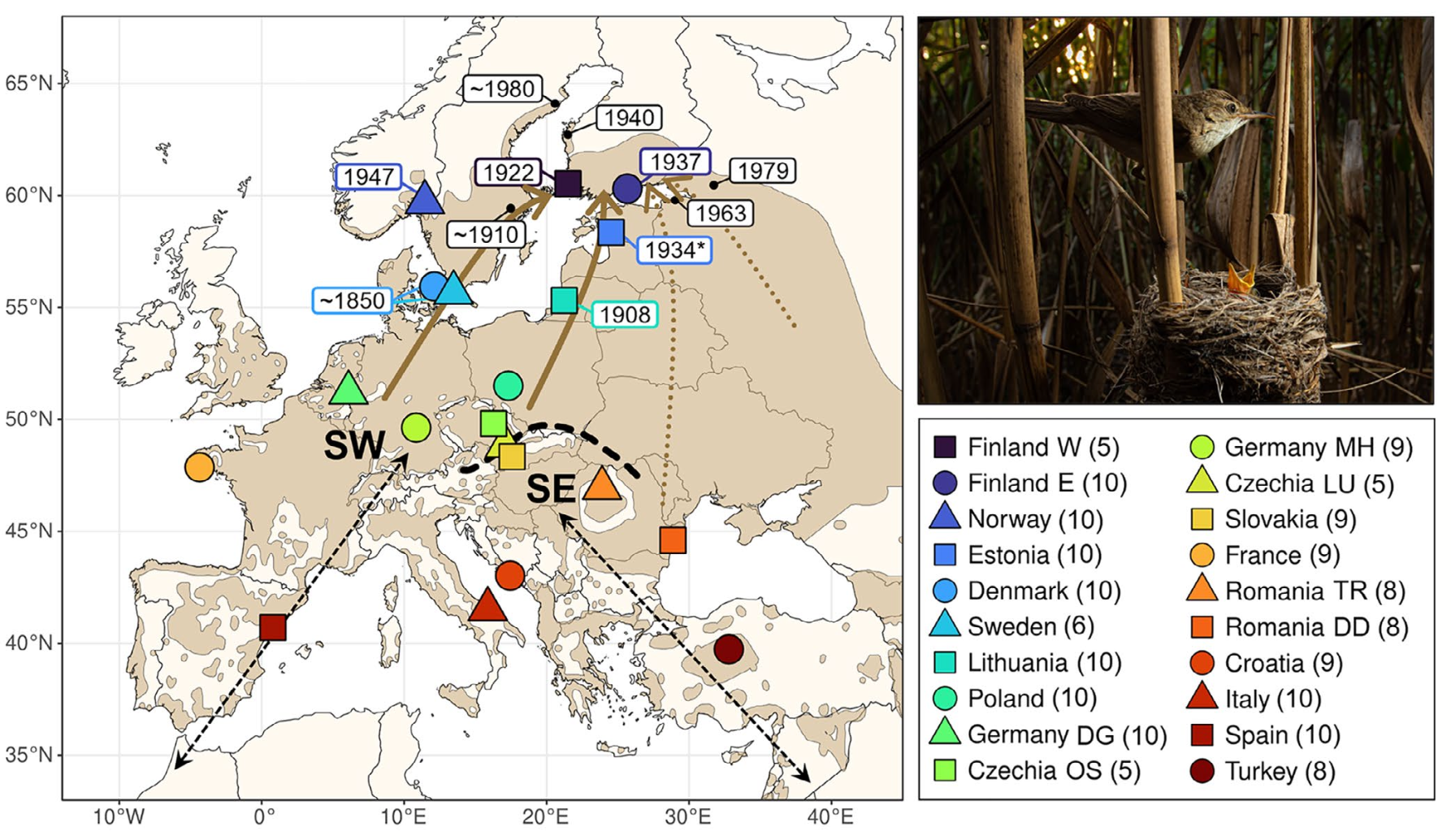
Figure 1 Left: Map of the reed warbler's current breeding range (in brown) in the study area (distribution data from BirdLife International and Handbook of the Birds of the World 2024). The hypothesised expansion pathways to Finland are illustrated with brown arrows, of which solid arrows denote the proposed routes on the basis of the results of this study. The species' migratory divide in Central Europe is indicated with a black dashed line (following Procházka et al. 2013), with populations on the different sides of the divide using either a southwestern (SW) or a southeastern (SE) route between their wintering and breeding grounds (general directionality of these routes indicated with black dashed arrows). The sampling sites for molecular data are marked on the map with filled shapes coloured by latitude order, and the legend (bottom right) shows the site names with the number of individuals used in molecular analyses. The year of first recorded occurrence is denoted on the map for respective sampling sites or otherareas (small black dots) within the newly colonised range. The * by the Estonian first occurrence indicates the year of the first record of the species in over 60 years, although a single nest was reported already in 1870. Top right: A common reed warbler at its nest. Photograph: Deryk Tolman.
The results from all three different types of data pointed to the same direction, showing that the Finnish population of reed warblers arrived from central and western European countries, expanding northward along the two sides of the Baltic Sea and then meeting again in Finland. Moreover, the results suggest that reed warblers seem to have avoided any founder effects: no decrease in genetic diversity was found, and a clear cline was detected only in the rarest alleles. As the expansion happened in a short span of time, these results are unexpected, but interesting.
Climate and environment change are driving more and more species to change their distribution, expanding and colonizing new areas at the edge of their range. This study shows that reconstructing a species’ expansion is possible by combining different types of evidence even when the genetic signal is weak. This information can be useful to have an insight on how well other species are dealing with the same pressure that the warblers are dealing with. While it is good news that this particular species shows no genetic diversity decline, we don’t know if they are an exception, and more examples from the wild are needed.